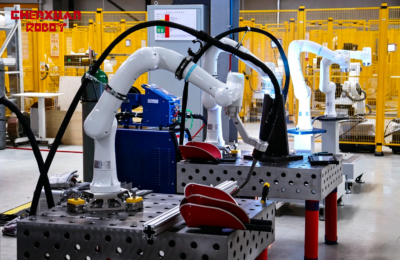
Recently, President Dong, on behalf of Shandong Chenxuan Robot Technology Co., Ltd., visited European countries such as Spain and Portugal, conducting in-depth inspections of the local robotics technology ecosystem and bringing back valuable insights for the company’s development. This trip not only exposed us to cutting-edge technological scenarios but also provided a clearer understanding of market demands and cooperation models in Europe.
一、Technical Highlights: Innovation in Europe’s Robotics Industry
• Spain: Flexibility and Scene Implementation of Industrial Robots
At the Barcelona Industrial Automation Exhibition, multiple enterprises showcased lightweight collaborative robots adapted for small and medium-sized enterprises, particularly impressing us with the flexibility of robotic arms and human-machine collaboration safety in 3C product precision assembly and food sorting. For example, a company named “RoboTech” developed a vision-guided robot that can quickly identify irregular workpieces through AI algorithms with an error control within 0.1mm, directly referencing our optimization of production line precision.
• Portugal: Penetration of Service Robots in Livelihood Scenarios
In Lisbon’s smart city demonstration zone, cleaning robots and medical delivery robots have been deeply integrated into communities. The most inspiring example is the “intelligent nursing robot” used in local hospitals, which can monitor patients’ vital signs through sensors, automatically transmit data, and even complete basic drug sorting. This application of “medical + robotics” in segmented scenarios has shown us new market potential beyond the industrial sector.
二、Market Insights: Core Demands and Cooperation Models of European Clients
• Demand Keywords: Customization and Sustainability
Exchanges with Spanish automotive parts manufacturers revealed that their demand for robots focuses not on “standardized mass production” but on customized solutions tailored to production line characteristics. For instance, an established automaker proposed that robots should be compatible with welding processes for multiple vehicle models while reducing energy consumption by 30% compared to existing equipment. This differs from the domestic market’s emphasis on cost-effectiveness, prompting us to strengthen the flexible adaptability of our technical solutions.
• Cooperation Model: From Equipment Sales to Full-Cycle Services
Many Portuguese robotics enterprises adopt a subscription-based model of “equipment + operation and maintenance + upgrades,” such as providing robot leasing services while regularly dispatching engineers to optimize programs on-site and charging based on production line efficiency improvements. This model not only enhances customer stickiness but also feeds back technical iterations through continuous data, offering important references for our overseas market expansion.
三、Cultural Collisions: Details of Inspiration in European Business Cooperation
• “Rigorousness” and “Openness” in Technical Exchanges
During discussions with Spanish research institutions, counterparts would spend hours debating a specific robot algorithm parameter or even request demonstrations of fault reproduction processes—this extreme pursuit of technical details is worth learning. Meanwhile, they are willing to share undisclosed R&D directions, such as a laboratory actively revealing the topic of “remote control of robots combined with 5G,” providing new cross-border cooperation ideas.
• “Efficiency” and “Warmth” in Business Etiquette
Portuguese enterprises typically spend 10 minutes discussing culture, art, and other topics to break the ice before formal meetings, but they switch to a fast pace during negotiations, often confirming technical indicators and timelines on the spot. President Dong mentioned that during one negotiation, the other party directly presented a 3D model of the production line, requiring our robot solution to provide simulated operation data within 48 hours—this style of “high efficiency + experience focus” reminds us to strengthen the rapid response capability of technical plans in advance.
四、Development Revelations for Chenxuan
1. Technical Upgrading Direction: Focus on R&D of lightweight collaborative robots and visual recognition systems, and launch “modular customization” solutions for the European market. For example, split welding and sorting functions into combinable modules to lower customer procurement thresholds.
2. Market Expansion Strategy: Learn from Portugal’s subscription model, pilot “Robotics as a Service (RaaS)” overseas, provide predictive maintenance for customers through cloud data monitoring, and transform one-time sales into long-term value cooperation.
3. International Cooperation Layout: Plan to establish a technical alliance with the Spanish Robotics Association, jointly apply for EU “Industry 4.0″-related projects, and leverage local resources to enter high-end application scenarios such as automotive and medical sectors.
This European trip has not only allowed Chenxuan Robot to get close to global technological frontiers but more importantly, understand the underlying demand logic of different markets. As President Dong said: “Going global reveals that competition in the robotics industry is no longer a比拼 (comparison) of single products but a comprehensive contest of technical ecosystems, service models, and cultural adaptation.” In the future, the company will accelerate the implementation of its international strategy based on this inspection, enabling “Made in China Intelligence” to find a more precise entry point in the European market.
Post time:
Jun-05-2025
行业背景与项目启示
“European Robotics Technology Inspection Trip: Insights and Revelations from President Dong’s Visit to Spain and Portugal”需要结合真实制造目标理解。读者应关注该动态希望解决的产能、质量、用工或交付问题,并判断方案是否适配工件、工艺流程和现场条件。
进一步沟通应重点覆盖the customer’s process objectives, sample parts, quality expectations, plant constraints and the technical evidence required before a project decision,并通过图纸、样件、节拍数据或现场评审验证关键假设。
项目评估可从工件尺寸与种类、年产量、目标节拍、质量标准、能源介质和场地限制开始,再明确安全边界、上下游接口、换型方式和维护空间。
实施前还应约定可量化的验收标准,例如重复精度、工艺一致性、单位时间产量、换型时间、报警恢复和人员负担,并保留培训、参数备份和维护资料。