From programmed repetition to adaptive robotic execution
Beyond Fixed Automation
As manufacturing moves toward greater customization and shorter production cycles, conventional automation is being asked to do more than repeat a predetermined sequence. It must remain consistent while responding to changing workpieces, production layouts and surface-finishing requirements. AI embodied-intelligence mobile spraying robots are emerging as a sophisticated response to this challenge.
The Architecture Of Adaptive Spraying
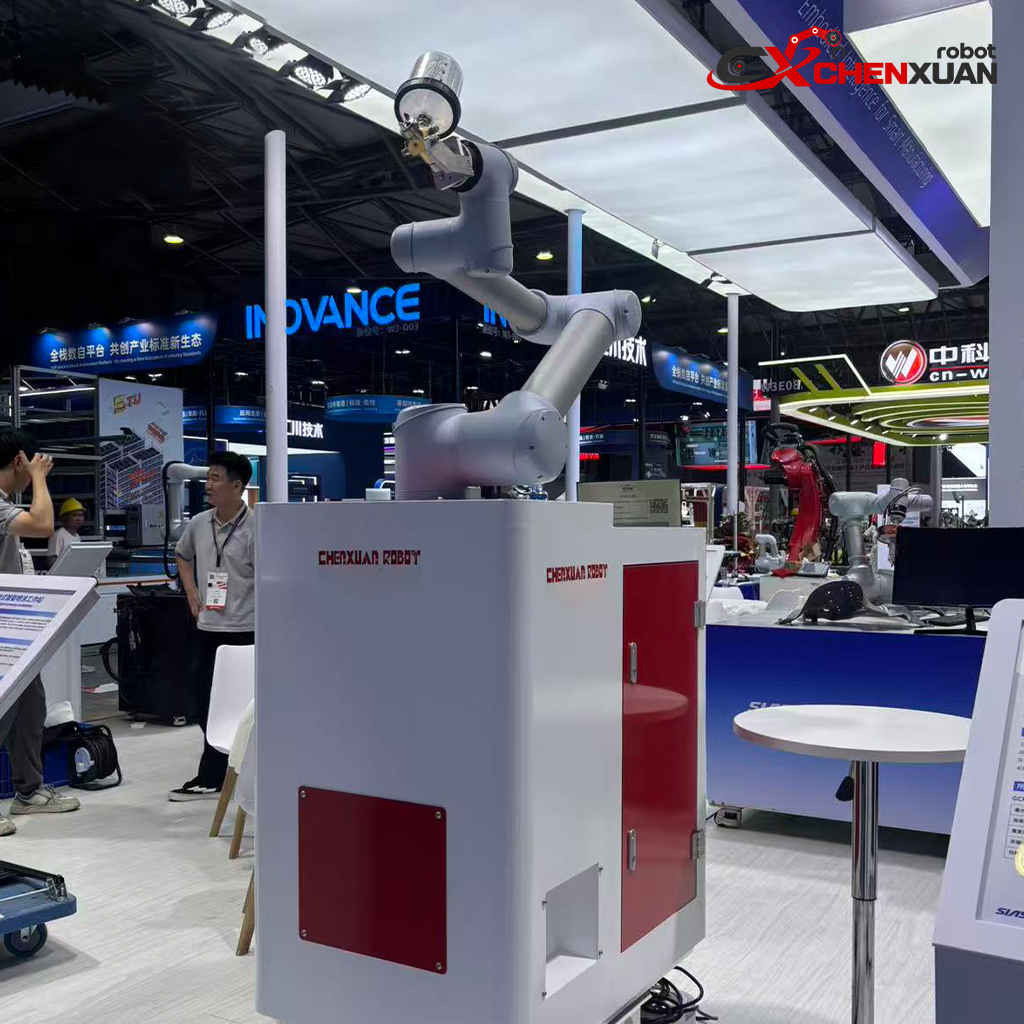
By integrating a mobile platform, industrial robotic arm, spray tool, perception system and intelligent control software, the technology creates a coordinated framework for automated surface finishing. Its value lies not simply in mobility, but in the relationship between perception, path planning and physical execution. The accompanying exhibition image illustrates this integrated form: an industrial arm, spraying end effector and compact mobile equipment cabinet working as one platform.
No Teach Spraying: Reducing Programming Friction
A defining capability is No Teach Spraying. Conventional robotic spraying often requires operators to record numerous teaching points for each workpiece. When a model, position or coating area changes, the program may need to be adjusted again. With appropriate vision sensing, workpiece recognition and path-planning functions, a No Teach system can assist in identifying the target surface and generating or refining a spraying path. It does not eliminate engineering validation, but it can reduce repetitive point-by-point teaching and make changeovers more adaptable.
Embodied Intelligence In Three Movements
Embodied intelligence connects artificial intelligence with a machine that can sense and act in the physical world. In mobile spraying, this principle can be understood through three linked capabilities: perception of the workpiece and environment, planning of a suitable movement and spraying route, and coordinated execution by the mobile platform, robotic arm and spray tool. The system is therefore positioned to support task execution in relation to real production conditions rather than merely replaying an isolated motion sequence.
Why Global Manufacturers Are Paying Attention
For overseas manufacturers, the appeal is closely connected to flexibility. The technology may be considered for large components, customized products, mixed-model production and surface-finishing tasks that are difficult to standardize with a fixed cell. It can also help reduce selected repetitive manual spraying activities and support greater consistency where spray distance, angle, movement speed and path continuity matter. Actual performance must be verified through application trials based on geometry, coating characteristics, finish requirements and workplace conditions.
A Forward-Looking Route To Flexible Finishing
AI embodied-intelligence No Teach mobile spraying robots represent the convergence of industrial robotics, mobile automation, machine perception and intelligent path planning. Their significance is not simply that a robot can move, but that spraying tasks can be reorganized around changing production conditions. For manufacturers exploring customized production, large-component coating or smart-factory development, No Teach robotic spraying offers a forward-looking route that connects intelligent perception with practical industrial execution.
行业背景与项目启示
“AI Embodied Intelligence No Teach Mobile Spraying Robots Redefine Flexible Surface Finishing”需要结合真实制造目标理解。读者应关注该动态希望解决的产能、质量、用工或交付问题,并判断方案是否适配工件、工艺流程和现场条件。
进一步沟通应重点覆盖目标工艺、负载与臂展需求、工装、安全方案、集成接口以及自动化可量化结果,并通过图纸、样件、节拍数据或现场评审验证关键假设。
项目评估可从工件尺寸与种类、年产量、目标节拍、质量标准、能源介质和场地限制开始,再明确安全边界、上下游接口、换型方式和维护空间。
实施前还应约定可量化的验收标准,例如重复精度、工艺一致性、单位时间产量、换型时间、报警恢复和人员负担,并保留培训、参数备份和维护资料。