Key Takeaway
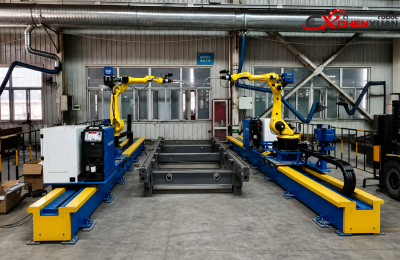
In large steel structure, construction machinery, and pressure vessel production, workpieces may exceed the effective range of a single welding robot. A gantry system carries and moves the robot, providing expanded workspace and a stable motion platform for automated welding of oversized components.
Exten ding The Robot Working Envelope
A standard welding robot relies mainly on its own articulated arm. When a workpiece is long, wide, or tall, the robot’s coverage may be insufficient. A gantry moves the welding robot horizontally, longitudinally, or vertically along its rails, expanding a limited working radius into a larger three dimensional workspace.
Improving Welding Efficiency For Large Workpieces
With a gantry system, the workpiece can remain fixed while the robot travels along it for continuous welding. This reduces repeated clamping, manual turning, and repositioning. For steel structures, machinery components, and bridge parts, this layout supports more continuous production.
Enhancing Stability And System Coordination
A gantry provides strong load capacity and stable travel, helping maintain consistent torch paths, welding speeds, and torch orientations. Its motion axes can also coordinate with the robot, positioner, seam tracking, and vision systems to handle more complex welding paths.
Building A Flexible Automated Welding Platform
Beyond carrying one robot, a gantry can support multi robot collaboration according to process requirements and integrate modules such as automatic torch cleaning and safety protection. It is not only a mobile base for the robot but also an important platform for connecting automation modules.
Conclusion
As manufacturing moves toward larger workpieces, flexible production, and intelligent automation, gantry systems will play an increasingly important role in automated welding. By expanding the working envelope, stabilizing robot motion, and connecting multiple automation modules, gantry coordination is becoming a key solution for improving robotic welding efficiency and consistency
行业背景与项目启示
“Gantry Enabled Intelligent Welding Expanding Robotic Reach And Production Efficiency”需要结合真实制造目标理解。读者应关注该动态希望解决的产能、质量、用工或交付问题,并判断方案是否适配工件、工艺流程和现场条件。
进一步沟通应重点覆盖目标工艺、负载与臂展需求、工装、安全方案、集成接口以及自动化可量化结果,并通过图纸、样件、节拍数据或现场评审验证关键假设。
项目评估可从工件尺寸与种类、年产量、目标节拍、质量标准、能源介质和场地限制开始,再明确安全边界、上下游接口、换型方式和维护空间。
实施前还应约定可量化的验收标准,例如重复精度、工艺一致性、单位时间产量、换型时间、报警恢复和人员负担,并保留培训、参数备份和维护资料。