Reducing The Burden Of Point By Point Teaching
Traditional robotic welding often relies on manually recorded teaching points. When the workpiece model, position or joint geometry changes, operators may need to spend additional time adjusting the robot program. No Teach welding technology is designed to reduce this programming burden. With suitable sensing and seam recognition functions, the robot can assist in locating the weld seam and generating or refining the welding path. The objective is not to remove engineering expertise, but to make that expertise easier to apply across changing production conditions.
Turning Weld Seam Data Into Action
The intelligence of the system begins with perception. Sensors and vision technologies can provide information about the workpiece, joint position and surrounding workspace. This information may then be processed to support torch positioning,welding direction and trajectory planning. Through this connection between perception and execution, the robot can respond
more effectively to variations that would otherwise require repeated manual adjustment. The welding process becomes not only programmable, but more context-aware.
Greater Flexibility For Complex Production
For manufacturers producing customized structures, large components or multiple product models, flexibility is a strategic requirement. A fixed welding routine may be efficient in a highly standardized environment, but less adaptable when product variety increases. AI No Teach welding robots offer a more flexible programming framework for these applications. By reducing repetitive teaching tasks, they can support smoother changeovers and help manufacturers respond to more diverse production demands.
Supporting Stable And Consistent Welding
Welding quality is influenced by torch position, travel speed, welding posture and seam alignment. Robotic execution can help control these variables according to the configured process requirements. When combined with appropriate seam sensing,welding parameters and process validation, the system can support a more consistent operating rhythm. Actual results depend on the robot configuration, sensing method, workpiece condition, joint quality and welding process.
Integrating Intelligence Into The Welding Cell
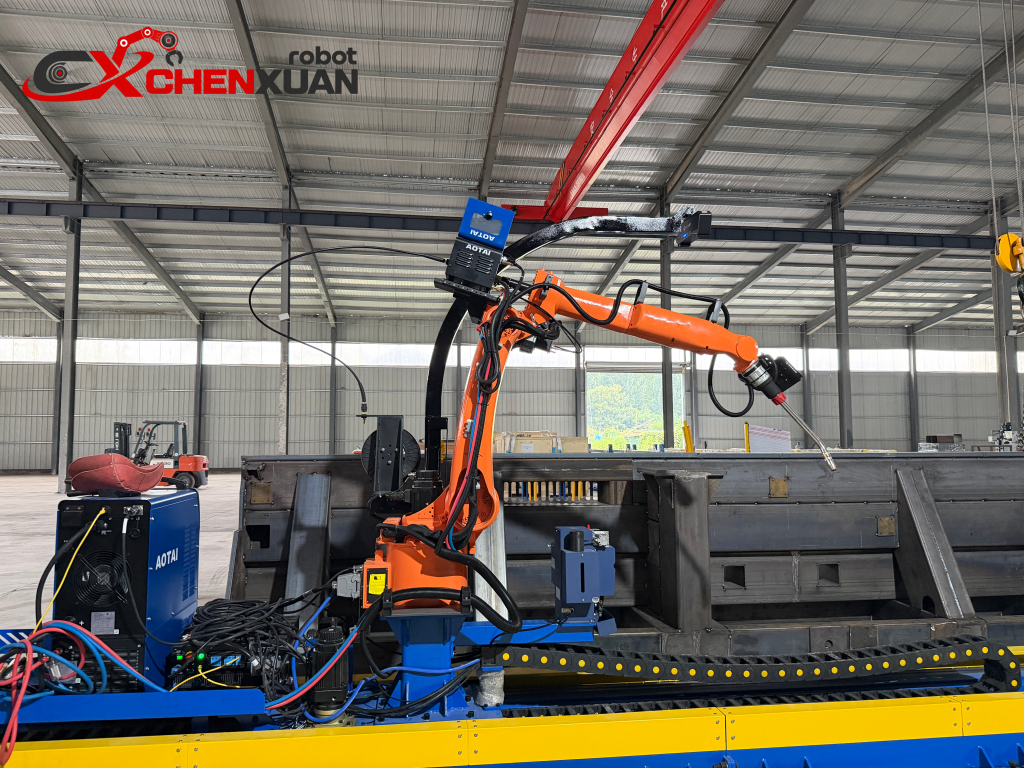
The value of an AI No Teach robot extends beyond the robot arm itself. It can be integrated with welding power sources,positioners, vision systems, safety equipment and other automation modules to form a coordinated welding cell. This system-level approach allows manufacturers to view welding automation not as an isolated machine, but as an intelligent production capability that can evolve with changing operational needs.
A Forward-Looking Path For Welding Automation
The defining advantage of AI No Teach welding robots is not simply the reduction of manual teaching. It is the creation of a more adaptive relationship between the workpiece, the weld seam and the robot. For manufacturers seeking greater flexibility,lower programming friction and more consistent robotic execution, No Teach welding represents a practical step toward intelligent and scalable automation.
行业背景与项目启示
“AI No Teach Welding Robots: Reframing Flexibility In Intelligent Manufacturing”需要结合真实制造目标理解。读者应关注该动态希望解决的产能、质量、用工或交付问题,并判断方案是否适配工件、工艺流程和现场条件。
进一步沟通应重点覆盖目标工艺、负载与臂展需求、工装、安全方案、集成接口以及自动化可量化结果,并通过图纸、样件、节拍数据或现场评审验证关键假设。
项目评估可从工件尺寸与种类、年产量、目标节拍、质量标准、能源介质和场地限制开始,再明确安全边界、上下游接口、换型方式和维护空间。
实施前还应约定可量化的验收标准,例如重复精度、工艺一致性、单位时间产量、换型时间、报警恢复和人员负担,并保留培训、参数备份和维护资料。